
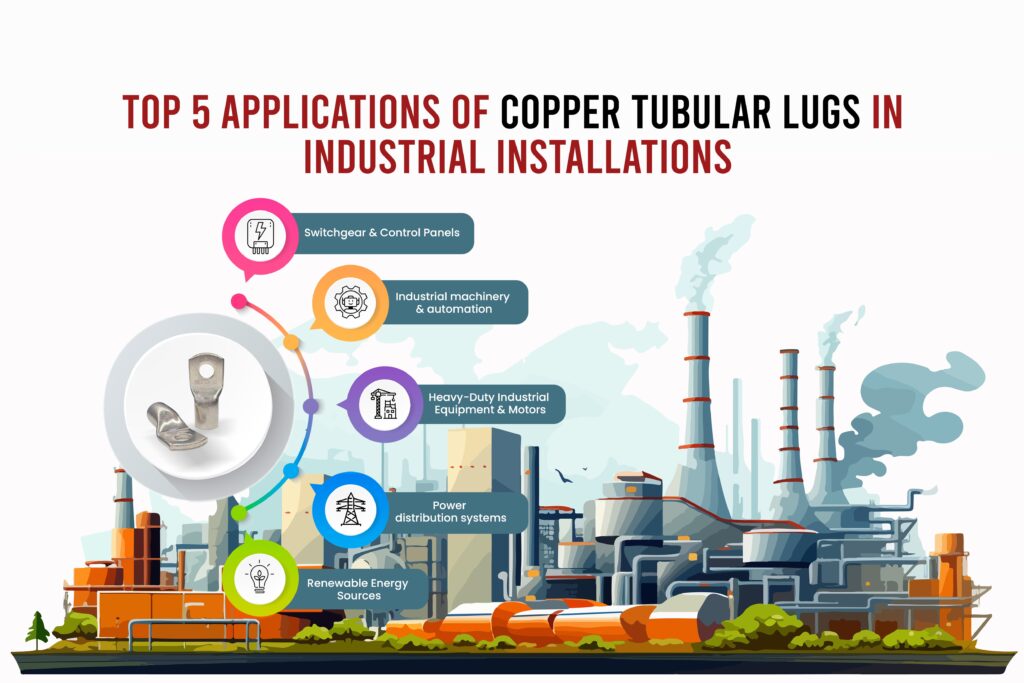
When we talk about ensuring the reliability and security of electrical connections, copper tubular lugs play a key role in a number of industrial applications.
This is because of their excellent conductivity, resistance to corrosion, and tensile strength, making them an ideal choice for terminating copper conductors.
There are a number of industrial applications of copper tubular lugs, right from switchgear panels to systems that utilise renewable energy.
These help maintain the deficiency, durability, and safety of the electrical infrastructure.
In this blog, we will talk about the top five applications of these lugs in industrial installations.
- Switchgear and Control Panels
- Industrial machinery and automation
- Heavy-Duty Industrial Equipment and Motors
- Power distribution systems
- Renewable Energy Sources
Now, the applications in detail –
The first application of Copper Tubular Lugs is in Switchgears and Control Panels
When it comes to industrial environments, the key component of an electrical system is switchgear and control panels. These propel power wherever it is needed and protect the system against faults.
In these panels, tubular-shaped copper lugs are popularly used to ensure that cables are terminated, ensuring safe and close connections with terminal blocks, circuit breakers, contractors, and relays.
On the other hand, switchgear applications require a higher level of meticulousness, accuracy, and reliability because of their complex and critical nature of operations.
In case a connection is poor or loose, it can lead to issues such as failure of the equipment, overheating, or even dangerous fire hazards.
If you want a stable electrical connection that provides consistent resistance to vibrations, you need to use properly crimped copper tubular lugs.
Their standard sizes and compatibility with various cable gauges make them simple to incorporate during panel building and maintenance.
Furthermore, their corrosion-resistant qualities allow for installation in locations with fluctuating temperature and humidity levels, ensuring long-term performance.
Second, important application is in Industrial machinery and automation
The machinery and automation systems at modern manufacturing units are heavily dependent on a stable and effective power supply to ensure efficient operations.
Copper cable lugs are widely used in connecting the power supply and control circuits with the drives, motors, sensors, and PLC (Programmable Logic Controllers).
These systems at factories generally operate under a number of difficult operating conditions, such as adverse temperatures, vibrations, dust, and are often subjected to varied loads.
These conditions can be withstood by tubular lugs made of copper thanks to their mechanical strength and durability.
Their crimping process is strong, and such connections do not loosen because of the inevitable thermal expansion and contraction cycles or vibrations.
It is important to note that when it comes to automation panels and control cabinets, there is a space constraint, which is why tubular-shaped lugs are used for their compact design.
It allows for space-efficient management of the cable, making it more accessible for troubleshooting and maintenance.
Additionally, these lugs are available in both forms, insulated and non-insulated, so installers can pick the correct type of lug on the basis of the protection and security required.
Copper tubular lugs are in huge demand when it comes to Heavy-Duty Industrial Equipment and Motors application
When we talk about heavy industries such as oil and gas, shipbuilding, metallurgy, mining, and more, the conditions are demanding. To match it, heavy-duty industrial equipment and motors are used.
Now, this machinery requires a high amount of current and is connected with the help of thick cables made from copper, which need to have terminations that are safe and reliable.
The ideal choice in this scenario is copper tubular lugs for terminating these high-current cables to motor terminals, distribution panels, and control systems.
The composition of these lugs is robust, ensuring that the connection formed can withstand the mechanical stress and thermal movements without loosening or degrading.
For example, when it comes to mining, the equipment and cables are exposed to movement, vibrations, dust, and other such adverse conditions.
In such times, the most important part of an electrical connection is the ability of the lug to maintain the integrity of the connection.
When a lug made of copper is properly crimped, it ensures the safety of the electrical connection, which in turn reduces the need for maintenance, along with the risk of defects, faults, or failures.
Furthermore, in areas such as chemical plants or oil and gas factories, it is especially crucial to ensure that a secure connection is maintained.
Tubular lugs made from copper comply with the standards that are needed for such risky environments, especially when sleeves are insulated and fireproof.
Copper tubular lugs play an notable role in Power distribution systems
The most significant application of copper tubular lugs is in industrial power distribution systems, where efficient current conduction and long-lasting connections are important.
Reliable electrical connections to avert energy loss, heat build-up, and electrical malfunctioning are important in big manufacturing complexes, processing facilities, and commercial buildings.
Copper tubular lugs connect high-capacity copper cables with busbars, circuit breakers, transformers, and other equipment of power distribution.
Their significance is that they can sustain a low-resistance contact even with high current loads. Because copper is such an excellent conductor of electricity, these tubular-shaped lugs provide as little power loss as possible with effective transmission of current.
Additionally, their structure facilitates secure crimping to form a firm mechanical and electrical connection between the terminal and the cable.
This promotes long-term stability, minimises the possibility of arcing, and helps enhance the overall safety of the electrical system.
And lastly, a wide application of these lugs are in Renewable Energy Sources
As more industries use renewable energy systems, like solar photovoltaic (PV) and wind power installations, the demand for strong electrical connections becomes even greater.
These installations often include extended cable runs, outdoor exposure, and high DC voltages, all of which require secure and corrosion-resistant terminations.
Copper tubular lugs are widely applied in joining solar cables to inverters, combiner boxes, grounding systems, and battery storage equipment.
In wind energy applications, they are utilised to terminate cables in turbines, control boxes, and substations.
Corrosion resistance, especially when it is tin-plated, offers such lugs an optimum position for outdoor applications where the environment is humid, there is exposure to UV radiation, and temperature variations.
Further, such lugs are responsible for ensuring overall system efficiency by reducing power loss at the point of connection, which is critical to achieving the highest energy output in renewable applications.
Final thoughts
In the constantly changing world of industrial automation and renewable energy, the need for strong and secure electrical connections cannot be overemphasised.
Tubular copper cable lugs will remain at the forefront of energising progress, enabling innovation, and ensuring the safety and efficiency of industrial electrical systems for years to come.