
When it comes to electrical systems, no matter how small an electric component may seem, it is a critical component to your overall system, and its function is generally safety and reliability. One such component is the cable lug, an important component that connects and terminates cables securely to electrical components.
When dealing with wire and electrical equipment, whether a distribution panel, battery or control equipment, two main choices are presented: insulated and non-insulated cable lug.
Both cable lugs perform similar functions; however, they differ in construction, cost, safety and functionality in different environments.
Choosing a lug is not hard, but it will depend on your environment, current needs and what needs to be protected.
What Are Cable Lugs?
Cable lugs are devices that allow you to connect the end of a cable to an electrical component or terminal without the risk of having a loose connection or a dangerous situation. Chetna Engineering is your top choice for high-quality lugs.
Cable lugs provide a stable connection that helps connect electrical current to the electrical component terminal and lower resistance, reduced risk of heat, fire, hazards and increased efficiency for the components and electrical system.
Such lugs are typically composed of copper, aluminum and/or tinned metal; the lug is crimped or soldered on the cable, then bolted or screwed onto the terminal.
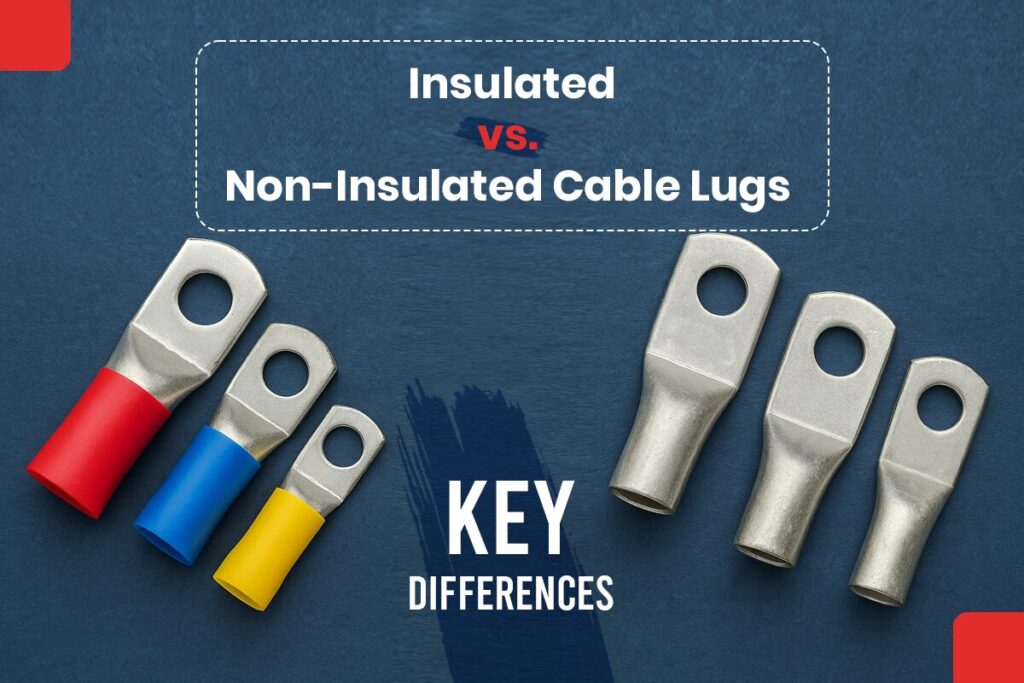
The two main types are insulated and non-insulated cable lugs. The main difference is whether or not they have an external, protective layer, which determines their use in different environments.
Insulated Cable Lugs:
Design and Advantages:
Insulated cable lugs are fitted with an additional exterior, which can be made from either PVC, Nylon or heat-shrink polymers. This covering will provide protection for the crimp barrel and sometimes the neck of the lug.
The insulation protects the cable lug from contact, moisture and dust. The insulation provides mechanical protection, as well as safety protection during installation and operation, since it reduces the risk of accidental short-circuiting and/or electrical shock.
Insulated cable lugs are used predominantly in situations where cables are frequently disturbed or have minimal exposure.
The insulation also affords durability to the connector from contaminants such as water or corrosive materials.
Insulated lugs are often colour-coded and designed according to wire sizes, to ensure that the installation site accepts the correct wire size in a quicker process, which reduces installation time and risks of wiring errors.
This is especially useful for electrical contractors who are working on high-speed sites or complex wiring assembly which have to meet tight deadlines, such as an automotive wiring harness or control panel installation.
Best Applications:
Insulated cable lugs are utilised primarily within residential electrical systems, where safety is a priority and wires may be placed in the hands of untrained or inexperienced users or occupants.
They are also used frequently in automotive, marine, and industrial control systems where the environment may be damp or corrosive.
Any situation where touch protection and/or environmental exposure protection is necessary, whether from dust or moisture, is an ideal application for the insulated lug.
Non-Insulated Cable Lugs:
Design and Advantages:
Non-insulated cable lugs, as the name implies, lack any outside protective layering. They consist of a bare metal barrel and palm and therefore provide a simple and low-profile termination for electricity.
Non-insulated lugs allow for better thermal dissipation, which is a bonus in applications requiring high current or high temperature.
Non-insulated cable lugs are often preferred in industrial and heavy-duty functions and applications where high current levels are mandated but space is an issue.
Another beneficial aspect of non-insulated cable lugs is flexibility. They will solder, crimp, and can be utilised with the addition of external insulated products like heat-shrink tubing.
Since they are designed and produced without insulation, they have a lower price point and a lower cost of manufacture. This can be an important consideration when purchasing and managing large quantities or limited budget factors.
However, because they lack insulation, this type of lug should be installed carefully and professionally to make sure the spacing and sealing properly encapsulates the power cables in an enclosed situation.
Best Applications:
Non-insulated lugs from Chetna Engineering Co. are often installed in the industrial part of the electrical industry, such as electrical enclosures, switchboards and ground systems.
All of these applications protect cables, so there isn’t typically a need to have insulated connectors on each cable.
Non-insulated lugs are accepted in feasible areas where there are little or no opportunities for physical contact, or where the current carrying capacity of equipment is most important and a decreased size is most important as opposed to electrically-aided shock protection.
Which cable lugs should you go for: Insulated or Non-Insulated?
Performance and safety:
The main difference between insulated and uninsulated lugs is the level of protection they provide.
Insulated cable lugs provide a protective barrier that protects the terminal from environmental issues and from accidental contact, making them ideal for use in exposed applications.
Non-insulated lugs will allow for greater conductivity, which can be used in a protected area where the enclosure securely contains the power cables throughout from ambient conditions.
In terms of performance, non-insulated lugs are a better option for high current applications as they do not have insulation, which causes heat to not be ventilated away as effectively.
Cost and installation:
Insulated lugs will generally cost more than non-insulated cable lugs because of the cost of materials and additional fabrication processes.
Insulated lugs will save you installation time because they will almost always include colour coding, ease of handling and a built-in protection from accidental touch.
Non-insulated lugs can be cheaper in price and smaller than insulated lugs, and are great for applications where lug assembly needs to be done in large quantities, such as in industrial or internal applications that control the electrical safety as a primary safety management process.
The installation tools may also differ between the two. Insulated cable lugs will often need a crimper with specific colour-coded dies, whereas non-insulated lugs can be crimped with a standard hex or indent crimper.
This may cause a delay or force an adjustment in your tool selection and usage on-site, or in a shop when you would be crimping or inserting multiple types of connections.
Applications:
Your decision may depend mostly on the installation environment and some safety considerations. We, at Chetna Engg., can help you decide:
Insulated lugs are better in residential, commercial or any location where you know that touching a live lug is an actual option. In addition, insulated lugs have built-in protection and are easier for electric systems to work with than standard non-insulated lugs.
Non-insulated cable lugs would generally be the better lug choice in mostly sealed or always protected environments, where electrical performance is more important than a physical safety concern.
They are often smaller and better able to handle current, which makes them perfect for industrial applications, high-power systems, and installations inside enclosures, cabinets, or switchgear.
Conclusion:
Choosing between insulated and non-insulated cable lugs is a matter of applying the right product to your electrical environment, safety concerns, and performance requirements.
Insulated lugs are easier to manage and protect, making them useful for exposed, everyday applications, while non-insulated lugs, if handled properly, are more suitable in providing good performance in industrial applications where insulation is managed from the system level.
Regardless of whether you are working on a home, vehicle, marine equipment, or large industrial panel, understanding the application thoroughly will allow you to make the safest, most efficient choice possible.
Choose Chetna Engineering’s cable lugs for the best electrical performance.
FAQ’s:
1) What is the difference between insulated and non-insulated cable lugs?
Answer: The key difference between insulated and non-insulated cable lugs is the surface layer of the lug. Insulated lugs are covered with a coating of plastic or vinyl around the crimping of the wire. Non-insulated cable lugs have no such protective coating.
2) Which type of cable lugs should I use for industrial wiring?
Answer: You should go for insulated cable lugs for industrial wiring, as they have additional safety as compared to non-insulated lugs. This is mainly because industrial environments are more prone to electrical contacts and short circuits. However, if safety is a secondary concern, you can also opt for non-insulated lugs.
3) Are there cost differences between insulated and non-insulated lugs?
Answer: Yes, insulated cable lugs are generally more expensive as compared to non-isulated lugs because of their exterior coating, their material, and the manufacturing process involved in adding the protective layer. Non-insulated lugs are cost-effective due to the absence of any coating.
4) What materials are used for insulated and non-insulated lugs?
Answer: Insulated and non-insulated lugs are basically made from the same conductive materials, such as copper or aluminium. Insulated lugs are additionally coated with plastic, nylon, or PVC for protection. The conductive part is generally made from brass or copper as it comes in contact with the wire.
5) Can I use insulated lugs in high-temperature environments?
Answer: Insulated lugs are not ideally used in high-temperature environments, as the insulating material (nylon/PVC) can deteriorate or melt at high temperatures. It can lead to electrical failures and safety hazards. You can go for stainless steel lugs or nickel lugs that can withstand high temperatures for this application.